Artisanally authored by an imperfect flesh-and-blood human with hopes, dreams, needs, and even actual feelings.
The Telospore
A telospore is a node in a network whose sole purpose is to grow. It’s too stupidly small and simple to have any other option.
Eirdicht hosts a digital network of telospores via an always-running service. This service provides persistence for the telospores as well as a variety of ways to interact with them.
Eirdicht’s Essence
The essential unit (or atom) of Eirdicht is the telospore itself.
Each telospore exists within one space or another. Some people say that a telospore is also a space of its own, but let’s not confuse ourselves.
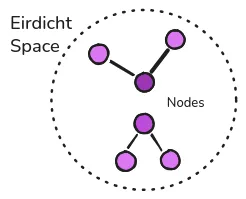
The first telospore, as stupidly simple and solitary as it is, is capable of delivering value. Value to you, according to you.
And what is value? It is what you reward. In Eirdicht-ville circularity is a friend.
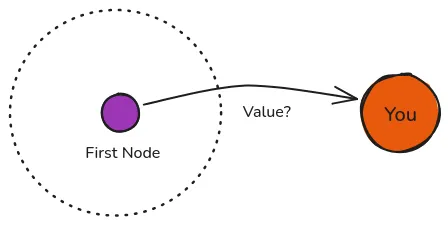
Each telospore’s purpose (its telos) is to grow. It grows when you reward it for delivering value to you. You are its judge, its jury, and also its executioner.
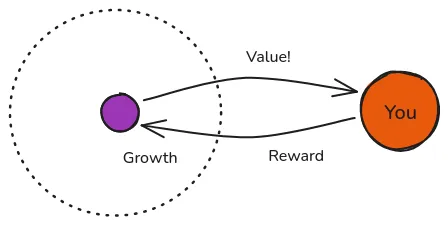
However, growth can be a bit tricky: it is much more than enlargement. Merely staying in the game or keeping things the way they are require growth. Mom & Pop shops (and single-cell bacteria) must grow continuously despite neither intention nor ability to get bigger. Living things all grow continuously, even after capping their size. While enlargement may pop to top of mind, it is only the most obvious of growth’s many dimensions.
It may help to envision each telospore as a seed (or a spore…) and yourself as its ecosystem. Or imagine the telospore as a startup and you are its market. Perhaps it is an entry-level new hire and you are its manager. The point is that you are absolutely necessary.
As for the telos of Eirdicht itself, it is to continually expand the set of growth-dimensions available to all of its telospores. Which, of course, are your telospores.
A New Type of Telospore: The Freq-Node
Value arises from having an impact; from causing change. Change worth rewarding.
Each telospore must clearly cause a change in you and that change must then be judged by you as good. Good enough to elicit a rewarding response from you that tells it “more of that, please”.
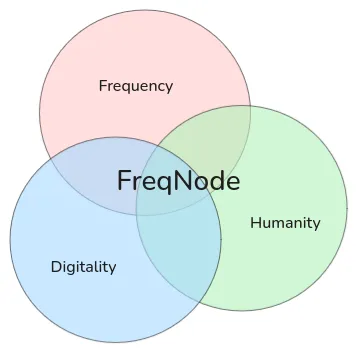
To achieve value delivery, Eirdicht starts you off with a single, specific type of telospore: the Frequency Node. Or FreqNode, for short. A FreqNode is about as simple as possible while being capable of delivering value. It operates at the intersection of three domains: frequency, digitality, and humanity.
Basic Structure
Like all telospores, each FreqNode node has an input side, an output side, and an active memory in between.
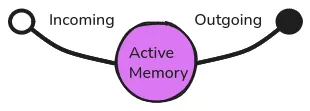
The Input Side
The input side is like a sensor: whenever it is “touched”, it adds an event to the memory.
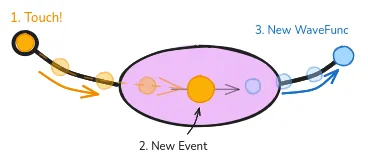
Whenever a new event is added, a new WaveFunc is generated and emitted.
The Active Memory Between
The memory of a FreqNode is a simple list of the times it has detected a “touch” from its input side.
Each new touch on its input side causes a FreqNode to emit a signal packet to its output side. This packet contains a WaveFunc, which is a periodic representation that roughly matches the frequency of the recent events in its memory.
In its simplest form, the WaveFunc is a sine wave with a defined period. For example, if the memory contains four events that have an average of 60 minutes between them, the wave will be defined as having a period of 60 minutes.
Since the WaveFunc is a function of time — f(t) — its value can be resolved for any future time. Past times too, but there’s little value in that.
A WaveFunc’s resolved value is adjusted by a time discount, or a gradual decay in its resolved value over time. This means that WaveFuncs wilt; frequent updates are needed to generate relevant (and valuable) outputs.
Each new WaveFunc packet is a state update to the network, not an actual event in itself. It is post-hoc but predictive, meaning “a specific action just occurred, so here’s the info you need to predict its next occurrence”.
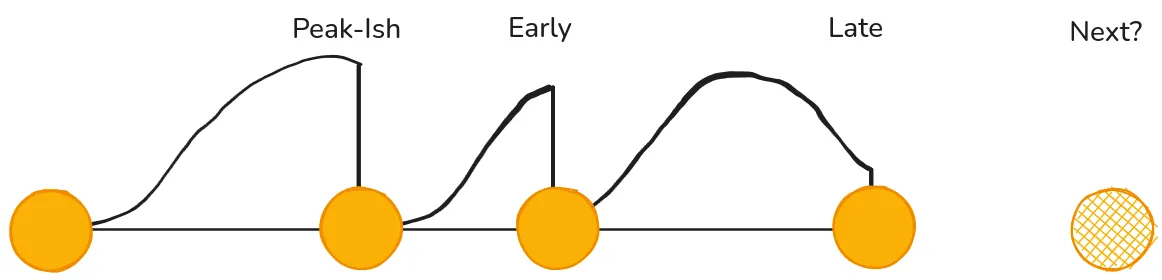
The value of a freshly updated WaveFunc always resolves to 0.0. Then its value rises gradually throughout its period until its peak value of 1.0. The peak, say 60 minutes after the reset, is like the fully-open position of a valve. It is the midpoint of a probablistic “window” of the event’s next occurrence. No guarantees, of course.
The Output Side
The output side can be connected to another FreqNode, to a terminus, or to nothing at all.
Connected To Another FreqNode
When FreqNode A’s output side is connected to FreqNode B, Node B receives each of Node A’s WaveFuncs via its input side. This isn’t a “touch” but it’s a fresh WaveFunc nonetheless. Since a fresh WaveFunc resolves to a zero value, there’s almost no chance of causing further effects.
FreqNode B may also be receiving the outputs of other FreqNodes. When a FreqNode has multiple inputs, it uses a decision function to manage its own outputs.
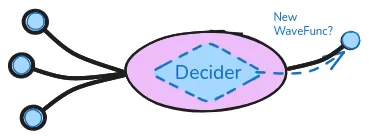
Each time it receives an updated WaveFunc, it immediately executes its decision function. Additionally, it also regularly resolves (via a tick) the sum of its input values and will emit a WaveFunc of its own when is aggregate value crosses an activational threshold.
Connected To A Terminus
Terminus just means delivering the signal to Eirdicht itself, which passes it on to the “outside world”. This typically involves an event being fired or a webhook being called.
Connected To Nothing At All
Node-related events will still appear in console logs and perhaps be reflected in visual UIs. They just won’t impact the network.
How This All Ties Together
Imagine a button as the “sensor” of the touch.
Since each WaveFunc is re-calculated and reset on every new touch, it will have adjusted slightly to project a new future.
In this sense, the rhythm is a bit of a dance: the human can touch at any time. Whether early, late, or whenever, there is no wrong time because the human is an independent agent. It is the job of the node & network to immediately adapt, which it does despite its stupid simplicity.
Who is always in charge? You, the human! Everything in your Eirdicht came from you. Everything in it is about you. It is nothing without you and remains your choice to continue engaging with it.
Still, a FreqNode is very slightly agentic. It has the minimum necessary amount of high-quality information — and the capability, if you grant it — to induce an action from you. Which action? Any action, as long as it results in you tapping the FreqNode’s “button”. This rewards the FreqNode with a stay of execution and a slightly improved chance of a good follow-up prediction.
Death
nodes…just die. like everything else just dies. forgotten. irrelevant. no longer impacting anything as “itself”. they had no right to “life” in the first place, and simply failed to continue carving it out. nothing technical needs to happen. nothing mathematical either. i mean it can, and probably it will, but